All our PDFs are sent out attached to emails, the same or next working day at the latest. All our products are available in PDF format worldwide, but hard copy print versions are only available in the UK.
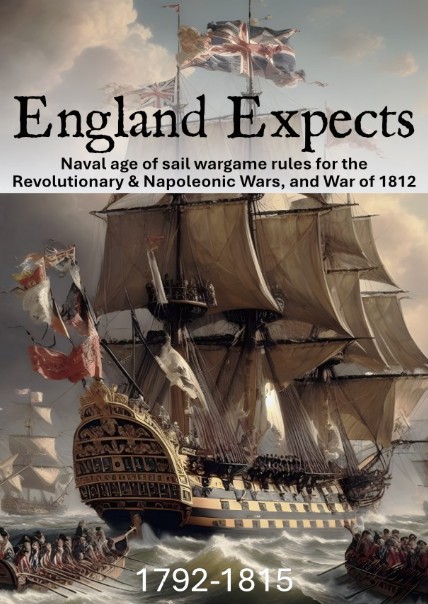
ENGLAND EXPECTS
Naval wargame rules for the Revolutionary & Napoleonic Wars, and the War of 1812
Buy England Expects naval wargame rules (PDF version) £7.49
England Expects naval wargame rules (printed version, UK only, inc.p&p) £14.99
England Expects naval wargame rules includes sections on:
Starting weather conditions for various seas for wind, fog, &c.
Unique sailing rules system
Signalling
Leeward drift
Veering & tacking
Boxhauling & in irons
Running sail & sail shiver
Running foul
Heaving-to
Grounding
Pooping
Wind shadow
Cannon overboard
Towing
Jury rigging & rudders
Hull shapes
Gunnery
Small arms fire
Friendly fire
Swivel guns
Fire aloft, in the hull
Flooding
Heated shot
Bomb ketch shore bombardment
Boarding attempts
Striking colours
Secured prizes
Ships boats
Cutting out operations
Raising and dropping anchor
Turnings on springs & warping
Linking cables
Girt
Fireships
Plus discussions about rates of fire, damage, carelessness, the light room, thick smoke, gunnery, carronades, obusier de vaisseau, waterlogging, suction pumps including Coles-Bentinck chain pumps, danger to magazines from fire, tactics, doubling the line, falling out of line, en fluyte, crank & swift ships, East Indiamen & American big frigates.
The tabletop game is played with model ships, or counters, with several model scales directly accounted for in how the rules are set out, making the game easy to play no matter what scale ships are being used. There's lots of dice rolling for broadsides, and we've done intensive research to get results to match historic impact: so pistol shot initial broadsides raking the stern of a ship with carronades is going to be horrendously effective, cannon fire at random shot range (long range in modern parlance) not so much. Wind direction is tied to tabletop game sides, making working out the direction a ship is facing easy to establish, which is necessary since the sailing rules show how to veer, boxhaul, tack, etc. The number of ships in the battle can increase once you've mastered how the system works, but it's best to start with a few ships to master the basics. To summarise, it's quite a unique system in parts, developed over years of original research in some cases using first hand sources, such as Falconer's Maritime Dictionary (which is an 18th century gem!), and involved visits to HMS Trincomalee, HMS Victory, membership of the Navy Records Society, &c., coupled with what you'd expect: tabletop games, using tape measures and model ships, rolling dice, that sort of thing.